The History of Home Audio Systems


What do you listen to music on at home? What did your parents listen on? And your grandparents? Formats come and go… Sometimes they come back. Today we’ll talk about the more than one-hundred-year history of sound recording from the perspective of home audio equipment — what people listened to and on what devices around the world and in our country from the late 19th century, and how these practices changed by the early 21st century.
The Phonograph
1880s – 1920s
In 1877, Thomas Edison invented the phonograph, the first device for recording and reproducing sound. The invention caused a sensation. At the first demonstrations, many people didn’t believe their eyes and ears, thinking it was magic or trickery. For example, at the Paris Academy, one professor accused the physicists of ventriloquism, refusing to believe in “the ability of base metal to produce the noble human voice.” Phonographs also reached Russia — Edison sent one of the first units as a gift to Leo Tolstoy, which is why we have a recording of his voice today.
The Gramophone / Wind-Up Record Player
1880s – 1950s
The first truly popular home audio device was the gramophone, patented in 1887 by German-American inventor Emile Berliner. The operating principle was essentially the same as the phonograph, but instead of a cylinder, it used a disc — a record (though it would be a long time before it became vinyl).
The Radio Receiver
1920s – Present
The first radio receiver was created by German physicist Heinrich Hertz in the same year as Berliner’s gramophone, 1887, but the technology took some time to develop. By the early 1920s, the development of vacuum tubes had reached a level sufficient for radio broadcasting to appear in many countries.
We have collected in one place – US online sportsbook, excitement and sports, which gives pleasure and motivation.
The Turntable (Electric Record Player)
1940s – Present
The first electric-powered turntables appeared in the late 1920s. In terms of sound quality, they surpassed the contemporary gramophones and wind-up players due to their use of electronic signal amplifiers, and their pickup cartridges were lighter, which caused less wear on records. However, these turntables required electricity, an external amplifier, and a speaker, and were also significantly more expensive than mechanical ones, so they only became popular in the 1940s. Around the same time, the English language shifted from the word “gramophone” to “record player.”

The Radiogram
1940s – 1970s
The hybrid of radio and record player became the first “all-in-one” device. The first radiograms appeared in the 1930s and were made of polished wood to match furniture. This was a massive and expensive device — the first home entertainment center, with a much larger speaker than a regular radio receiver. Their rise in popularity came in the 1940s, linked to the advent of vinyl LPs. Some models were also produced with a built-in television.
The Cassette Deck (for Compact Cassettes)
1970s – Present
As soon as reel-to-reel tape recorders appeared, manufacturers tried to make the technology more compact and developed their own cassette formats. Gradually, the world was conquered by the compact cassette format, introduced in 1963 by the Belgian company Philips.
Component Stereo / Hi-Fi Systems
1970s – Present
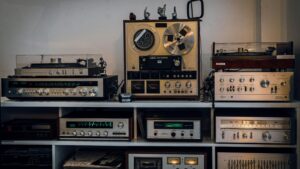
With the advent of Hi-Fi in the 1950s and stereo in the 1960s, manufacturers began offering a modular approach as a higher-quality alternative to all-in-one devices — you could choose speakers, amplifiers, and players of various formats according to your taste, replacing individual components as desired.