Creating 3D Printed Exhibit Replicas from Fossil Photography for Natural History Museums

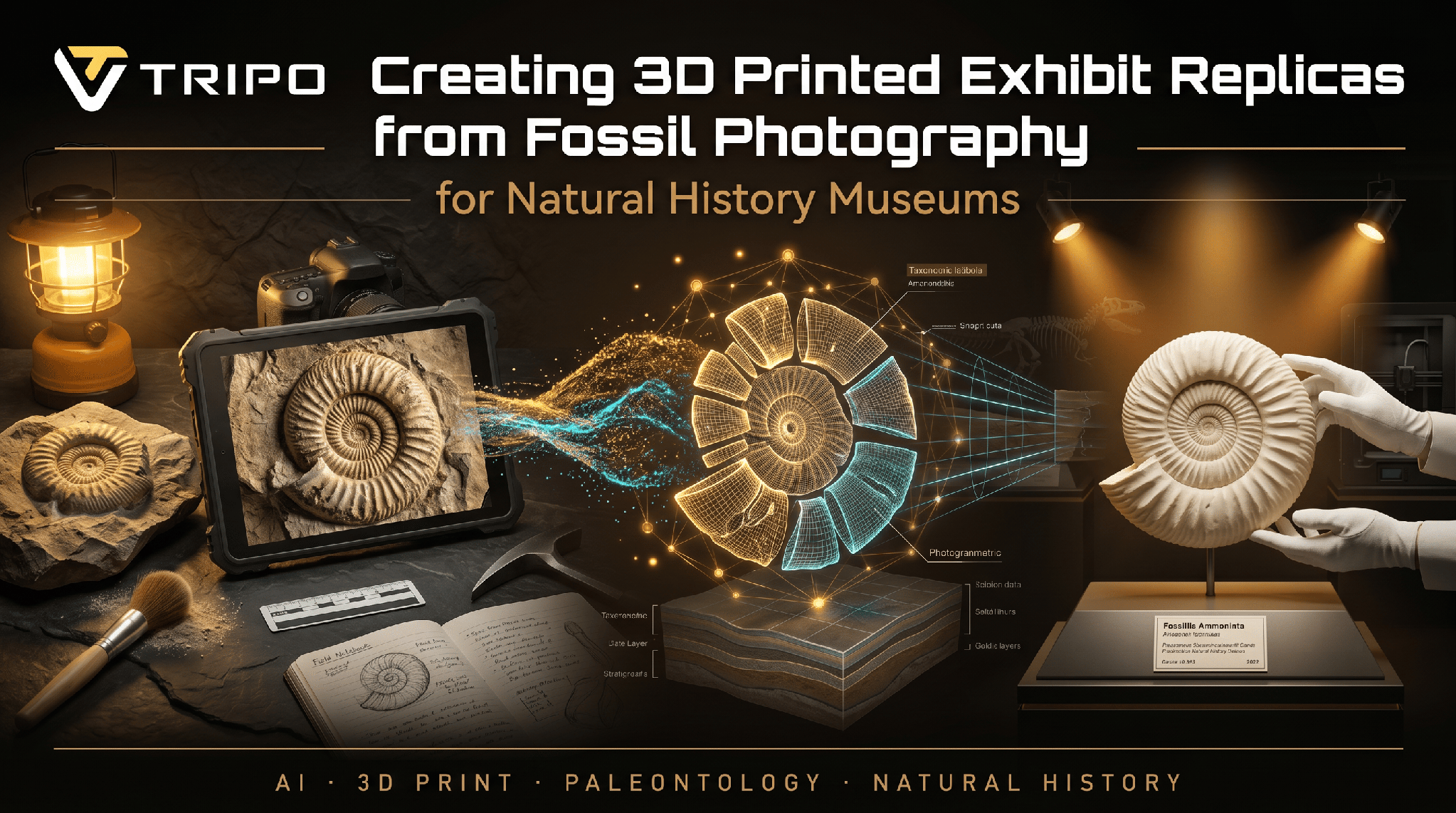

The natural history museum is always looking for innovative ways to make collections more accessible, interactive, and durable. Although original fossils are the main attraction in many exhibits, they are often rare and brittle, and not easy to view closely. Through Tripo 3D, institutions can convert fossil photographs into detailed 3D digital models, which can be used for research, education, and public engagement.
The image to 3D workflow allows one photo of the fossil to be created into a realistic 3D replica that can be used for exhibit, study, or hands-on learning. Tripo 3D allows museums to make significant specimens more accessible, whilst preserving the originals for future generations.
When ancient fossils come to life again
Most fossils spend most of their lifetimes behind glass. This helps to preserve valuable specimens, but reduces the visitors’ access to them. Replicas address this issue by providing an accurate copy for display in an educational area for visitors to view in detail.
Tripo 3D allows museum staff to digitize photos of fossils to preserve the form and essence of the specimens. These recreations can enhance exhibits and make them more immersive and engaging, from dinosaur teeth to ammonite shells.
Rare discoveries for all to use
Some fossils are fragile enough that they can’t be shipped and others are still in storage collections. Replicas enable museums to share these treasures without unnecessary risk of exposure.
A high quality reproduction can be exhibited in several locations, for outreach programs or for temporary exhibitions. This is a way of enhancing public access in the context of scientific integrity.
From reading fossil photographs to memorable experiences at the fossil exhibit
Photographs have long been essential to the documentation of a museum. Today, those same photos can be used as a springboard to new uses, such as digital reconstruction projects.
Using existing image archives, museum professionals can create museum models with Tripo 3D for exhibit design, educational workshops and interactive exhibits. As opposed to purchasing expensive copies, teams can create assets by using photographic references.
Developing touch-friendly learning spaces
A lot of visitors prefer hands-on learning. Making the opportunity for children, students and families to actually look at an object often helps them to better appreciate the nature of it.
The 3D printed fossil replicas foster curiosity by allowing people to hold, compare and inspect fossils. Visitors do not just read labels, but are able to interact with tangible models of life from the prehistory.
The experiences make exhibits more than displays, they are learning environments.
Allowing for exploration while preserving sensitive specimensFossils may deteriorate over time from handling or exposure to the environment or transportation. The preservation of the museum must be in harmony with the museum’s openness to the public.
Digital modeling is a practical solution. After Tripo 3D recreates a fossil, the model can be reproduced over and over again, and won’t damage the original fossil.
Complementary research off-site of the exhibition
These replicas have value to both visitors and researchers and educators as well. Digital models can be shared between institutions and integrated into virtual collections, and can be studied in ways that cannot be done with physical objects.
The advanced tools, driven by 3D Model Maker capabilities, further optimize the model creation process, helping museums to generate accurate, science-friendly representations more easily.
Creating a museum model of a fossil snapshot using Tripo 3D
Making fossil replicas can seem very involved, but with Tripo 3D it is very simple. From a photo to a printable model is a matter of just a few steps for museum teams.
Step 1: Select input and upload
First, go to the Tripo AI workspace and choose an input method. In fossil projects, Image to 3D can often be the best choice as it is based on photographs. Upload an image of the fossil specimen (and details) in a JPG, PNG or WEBP format.
Step 2: Configure settings
Then select the level of mesh and texture for the project. These are helpful for making more detailed replicas of exhibits, but can also be used for educational demonstrations with lighter settings. These changes aim at improving accuracy and efficiency.
Step 3: Generate and refine
Click on generate and let Tripo 3D create the initial model. Once processed, apply refinement tools to help clarify and separate components and/or organize the important features of fossils. Such options can lead to a refined appearance.
Step 4: Export
When you are satisfied, export the model to the format that is required for your workflow. Tripo 3D can handle several industry standard file formats. The image to STL process is convenient for museums that are in the process of creating printable replicas.
Image conversion into 3D models for exhibits in museums
Natural history museums can better safeguard and disseminate any rare findings through conversion of fossil pictures into physical models. The image to STL technique helps create realistic and functional exhibits by converting good fossil photos into 3D models, which are used in creating replicas of the fossils for museum display. This creates the advantage of handling such models without damaging the original findings, thereby increasing accessibility to visitors.
Reaching prehistoric finds to contemporary viewers
A number of natural history museums are facing an increasing demand to provide a compelling visitor experience while safeguarding irreplaceable collections. The development of digital modelling and replica production is an effective approach to achieve both of these objectives. With the conversion of fossil photography to replicas of exhibits, institutions can make their resources more accessible, enhance their education programs, and preserve original specimens.
Tripo 3D offers a real step-by-step route from image capture to models that can be shown to the public. Museums can take advantage of Tripo 3D to open new avenues in sharing prehistoric finds whether they are classroom materials, interactive displays or traveling exhibits. Discover the possibilities of Tripo 3D for education, preservation and engaging visitors with one photograph of a fossil.